
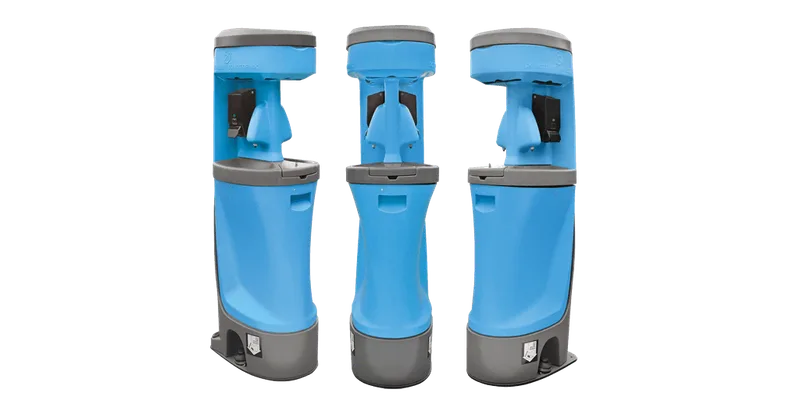
Locate the washing need before choosing the station
Handwashing uses water and soap; it is not the same function as a sanitizer dispenser or a private toilet cabin. Confirm whether the proposed toilet arrangement supplies washing or whether a separate station is required. Do not infer an included basin from an equipment name.
Identify where users are when they need to wash: leaving toilets, working in a distinct area or taking part in an activity elsewhere on the property. Consider who can follow the route and operate the offered equipment. This practical review does not certify food-service, workplace or accessibility compliance.
Compare a common point with separate activity points
A shared point can be straightforward when the groups can all reach it through a usable route. Check whether that route remains open during the activity and whether people waiting there would obstruct a door, another facility or ordinary circulation. A point drawn centrally on a map may not be central to actual movement.
Separate points can address distinct work or gathering areas, but adding stations does not automatically improve the arrangement. Each must be permitted, usable and reachable for care. Compare the benefit of reducing a difficult walk with the extra water, supply and checking responsibilities that a second location introduces.
Test the chosen distribution against the equipment
Ask how the actual station operates and what clean-water supply, used-water handling and consumables it requires. Soap and an appropriate drying arrangement belong in that discussion. Do not assume every portable station uses the same pump, connects to a tap or can share a nearby building’s utilities.
For more than one point, check the same requirements at each position rather than assuming a suitable central location proves the remote one works. A station that cannot be replenished or reached for used-water service is an incomplete proposal even if people can stand beside it.
Assign care to the arrangement you actually select
Name who checks each point, how missing water or supplies are reported and which replenishment or waste service is included. Describe the periods and intensity of use so the provider can discuss an appropriate scope. Site checks and provider servicing are different responsibilities; neither should be assumed to cover the other.
The quote should identify the actual station type and number, positions, dates, supplies, care, delivery and collection. Keep provider access available throughout the hire. If activities move or a previously shared route becomes restricted, review the distribution and service arrangement rather than move a station on an unapproved assumption.
Questions before you book
Is one centrally positioned station always enough?
Not necessarily. Check the actual routes, users, activity areas and waiting space. The central position must be usable and supported during the activity.
Are separate stations always the better choice?
No. Compare the practical benefit with the additional approved positions, supplies and care each point needs. Choose a supported arrangement, not a larger count by default.
Can I assume the station connects to a nearby tap?
No. Confirm the offered model’s water and used-water arrangements and the property’s permission and suitability before relying on a connection.
Who refills soap and water?
Agree that explicitly. Identify site checks, included replenishment and the way to request assistance; do not infer those duties from delivery of the station.